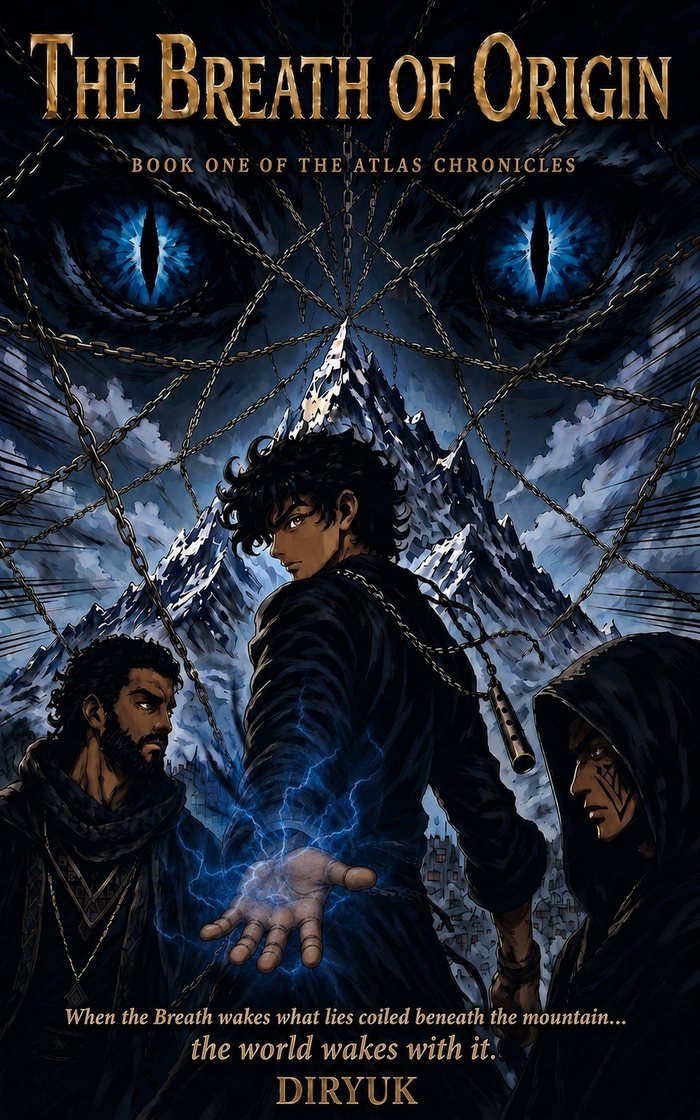
The Dawn of Tizi n’Ifri
He is fifteen, and everything he loves fits inside one house — his grandmother, the mountain, a flute nobody taught him to play. Then, in a single night, that life turns to tragedy, and he is hunted through the dark by things wearing the faces of people he knows.
A shepherd is saved from the possessed by a stranger, and never sees his old life again.
An evening like any other — until Tafar comes home to find his grandmother on the floor. What follows is a nightmare that leaves him hunted through the dark, and saved, at the last moment, by a traveller named Kassim.
What comes next is his introduction into a secret order, and the true start of the hunt: dungeons, missions, danger, while he tries to learn who he really is, what the ancient presence was that he met the night he nearly died, and who is responsible for his grandmother’s death, and why.
What follows is a mountain lake where the real training begins, an open tournament he has no business entering, and a man in a dark robe who walks away from four bodies without leaving a single print behind him. By the last page, Tafar knows what he can do. He still has no idea who he really is.
Chapter One — The Curtain Rises
A hand settles on Tafar’s shoulder.
Light. Warm as a stone left out in the sun.
« Up you get, little one. Dawn waits for nobody. »
Granny Izza never speaks louder than a breath — a voice cut for confidences, for prayers murmured at the edge of the fire, for the things you keep between yourself and the night. Tafar opens one eye. The thatched roof. The smell of bread on hot stone. The blue cold of dawn seeping under the door.
Everything in its place.
He stretches. At fifteen he is lean as a young mountain wolf — more sinew and bone than flesh, shoulders broad for his age, skin darkened by days under the sun of the ridges. He slides his flute into his belt — he never sleeps far from it, and has never been able to say why — and comes to the fire.
Granny Izza fills the kitchen the way an old olive root fills the ground: small, knotted, anchored.
Written the way a manga is drawn.
Short chapters, hard cuts
Scenes end on the beat that hurts, not on the explanation. Nothing is summarised afterwards for safety.
Powers are shown, never taught
No status screens, no system tutorials. You work out what someone can do by watching them do it, and by noticing who goes quiet in the room.
A world that predates the map
An old Amazigh world of the Atlas — its mountains, its clans, its night ceremonies. Not a European kingdom with the names swapped out.
Competence over luck
The veterans are genuinely good at their work. When someone wins, it is because of something you were shown earlier.
The Dawn of Tizi n’Ifri
Seventeen chapters. Yours in a minute, on any device.